
Understanding

The risk gene riddle
It turns out that risk genes are a really important piece of the puzzle that helps us build our understanding of how a disease progresses.

How large DNA banks help us to make breakthroughs possible
Alzheimer’s Research UK recently awarded a £96,000 grant to Prof Kevin Morgan at the University of Nottingham to maintain and expand his large collection of DNA samples. This is to ensure he can continue his important research into the genetics of Alzheimer’s disease.

Blood test could bring new hope to Alzheimer’s clinical trials
A team of scientists at UCL have found that blood tests measuring the hallmark Alzheimer’s protein, b-amyloid (amyloid), could radically reduce the cost of clinical trials and potentially open the door to treating the disease earlier. The scientists studied a unique group of volunteers, who were all born in the same week in 1946. The…

AstronauTx secures £6.5 million investment for new approach to dementia therapeutics
First company created from Alzheimer’s Research UK’s Drug Discovery Alliance David Cameron welcomes new UK investment from Dementia Discovery Fund A new UK-based biotech company, AstronauTx Ltd, which builds on the work from the Alzheimer’s Research UK UCL Drug Discovery Institute (DDI), has received an investment of £6.5 million from the Dementia Discovery Fund (DDF).…
Top dementia researchers awarded prestigious Brain Prize
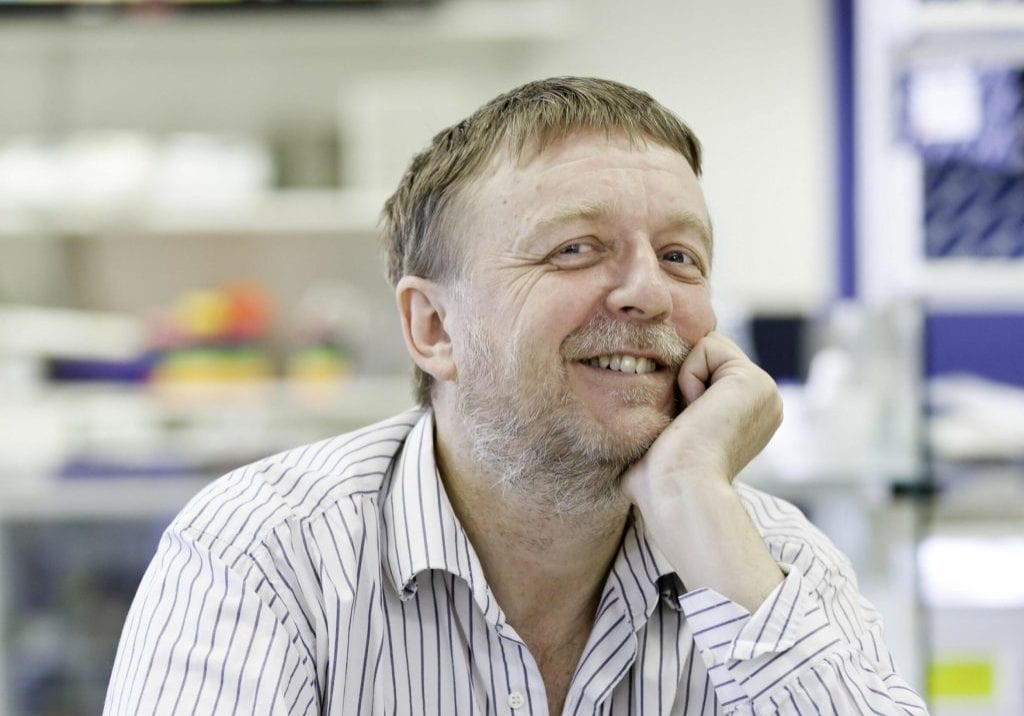
Pioneering dementia researchers Professors John Hardy, Bart De Strooper, Christian Haass and Michel Goedert have today been awarded the prestigious 2018 Brain Prize. The award honours outstanding contribution to neuroscience and recognises their innovative work on the genetic and molecular basis of Alzheimer’s disease. The four leading researchers will share a collective prize of one…

Alzheimer’s disease: The puzzle we’re so desperate to solve
At the Sanger Institute, where my PhD is based, we are fascinated by all things genetics, which may seem a long way from a person living with Alzheimer’s disease. Yet we know that certain gene mutations (a small error in a gene) can increase your risk of getting Alzheimer’s disease and now we are working to understand how and why that is.
TREM2 gene carries benefits as well as risks in Alzheimer’s disease
Researchers at the Washington University School of Medicine have studied the role of the Alzheimer’s risk gene TREM2, finding surprising evidence that the gene could also be protective against damage caused by tau tangles – a key hallmark of the disease. The results are published in the journal Proceedings of the National Academy of Sciences.…

Getting a genetic test for familial Alzheimer’s disease at 25
When people hear the word Alzheimer’s, many envision an elderly person shut away in the depths of a care home. As a 25-year-old, I was all too aware that young people assume that it’s a natural part of ageing, and nothing for them to worry about yet. But it’s not, it’s a brain disease that strips everything away from the individual – and it doesn’t just affect the elderly.

Brain amyloid PET scans enhance the diagnosis of Alzheimer’s
The build-up of amyloid protein in the brain is a hallmark feature of Alzheimer’s disease, and its detection often relies on the testing of brain and spinal fluid samples. More recently, PET brain scans have been able to highlight the presence of amyloid in the brain and are extensively used in research studies into Alzheimer’s,…

How many people develop Alzheimer’s in their 30s?
This week we’re helping Rita Pepper speak out about how Alzheimer’s has affected her family.
