Young onset dementia
Dementia information
Around 71,000 people with dementia in the UK are under 65 years old. This is called young onset, or early-onset, dementia.
In this section:
What is young onset dementia?
The word dementia is used to describe a group of symptoms that are severe enough to affect day-to-day life.
Symptoms can include:
-

confusion
-

thinking problems
-

problems with language, movement or vision
-

and mood changes
What is young onset dementia?
The word dementia is used to describe a group of symptoms that are severe enough to affect day-to-day life.
Symptoms can include:
-
confusion
-
thinking problems
-
problems with language, movement or vision
-
and mood changes
Dementia is caused by diseases that affect how our brain cells work.
It is often thought of as a condition that affects older people. But around seven in every 100 people with dementia in the UK are under 65 years old.
This is called young onset, or early-onset, dementia.
The diseases that cause young onset dementia and dementia in later life (late onset dementia) are similar. But the impact of young onset dementia can be different. People are often working, have financial commitments like a mortgage, and may have children still living at home.
This page contains information about the diseases that can cause dementia in people under the age of 65.
It is possible to have more than one type of dementia. For example, someone may have young onset Alzheimer’s disease and vascular dementia. This is known as mixed dementia.

This page contains information about the diseases that can cause dementia in people under the age of 65.
It is possible to have more than one type of dementia. For example, someone may have young onset Alzheimer’s disease and vascular dementia. This is known as mixed dementia.
Go to section:
What is young onset Alzheimer's disease?
Alzheimer’s disease is the most common cause of young onset dementia.
Around one in three people with young onset dementia have Alzheimer’s disease.
Symptoms of young onset Alzheimer’s usually start in people’s 40s, 50s or early 60s.

It is estimated that nearly eight in every 100 people with Alzheimer’s disease in the UK are under 65. This figure may be higher as younger people often experience delays or challenges in getting a diagnosis.
What is young onset vascular dementia?
Vascular dementia is the second most common cause of young onset dementia.
Around one in every five people with young onset dementia has vascular dementia.
Vascular dementia occurs when blood vessels in the brain are damaged. This affects how our brain cells work and causes them to become damaged too. Over time, this damage spreads and can lead to dementia symptoms.

Vascular dementia can cause some similar symptoms to Alzheimer’s disease, but speech and movement problems can be more common too. Symptoms can come on suddenly after a stroke or develop more slowly over time.
What is frontotemporal dementia?
Frontotemporal dementia, also known as FTD, often occurs in people under the age of 65. FTD accounts for around 12 in every 100 cases of young onset dementia.
FTD symptoms often begin between the ages of 40 and 60.

In FTD there is damage to cells in areas of the brain called the frontal and temporal lobes. These areas of our brains control our personality, behaviour and ability to speak and understand others.

There are different types of frontotemporal dementia (FTD). Sometimes doctors use the specific condition names, and other times they may refer to them all together as FTD.
Because these types affect different parts of the frontal and temporal lobes, the symptoms someone experiences can vary depending on which areas of the brain are most affected.
What is dementia with Lewy bodies?
Around one in 10 cases of young onset dementia is caused by dementia with Lewy bodies, or DLB.
In DLB, small round clumps of protein called alpha-synuclein build up in the brain. These clumps are called Lewy bodies. They are linked to damage to brain cells.
As more brain cells become damaged, it becomes harder for our brain to carry out normal processes. This leads to the symptoms of dementia.

DLB is closely related to Parkinson’s disease. The build-up of Lewy bodies is also found in Parkinson’s. That’s why symptoms like movement problems and tremors can also occur in DLB.
What is posterior cortical atrophy?
Posterior cortical atrophy (PCA) is a rare form of dementia. It usually affects people between 50 and 65.
It is most commonly caused by the same damage to the brain that is seen in Alzheimer’s disease. But in PCA, the damage is to cells at the back of the brain. This is the part of the brain is called the occipital lobe.
The occipital lobe processes information from our eyes and allows us to make sense of what we are seeing and where things are.

PCA usually begins by affecting a person’s vision. It causes symptoms that make moving around and carrying out daily tasks difficult.
What is Parkinson's disease dementia?
Parkinson’s disease is most commonly diagnosed around age 60 years old.
Parkinson’s disease affects brain cells that produce a chemical called dopamine.
The brain uses dopamine to send messages which control the body’s movement. When the brain cannot produce enough dopamine to control movement properly, Parkinson’s symptoms begin to appear.
As more brain cells are affected, problems with movement will get worse.
If you are worried about yourself or someone else who may be showing symptoms of dementia, talk to your doctor. They should assess your symptoms and medical history, and perform some tests.
Downloads
Dementia information
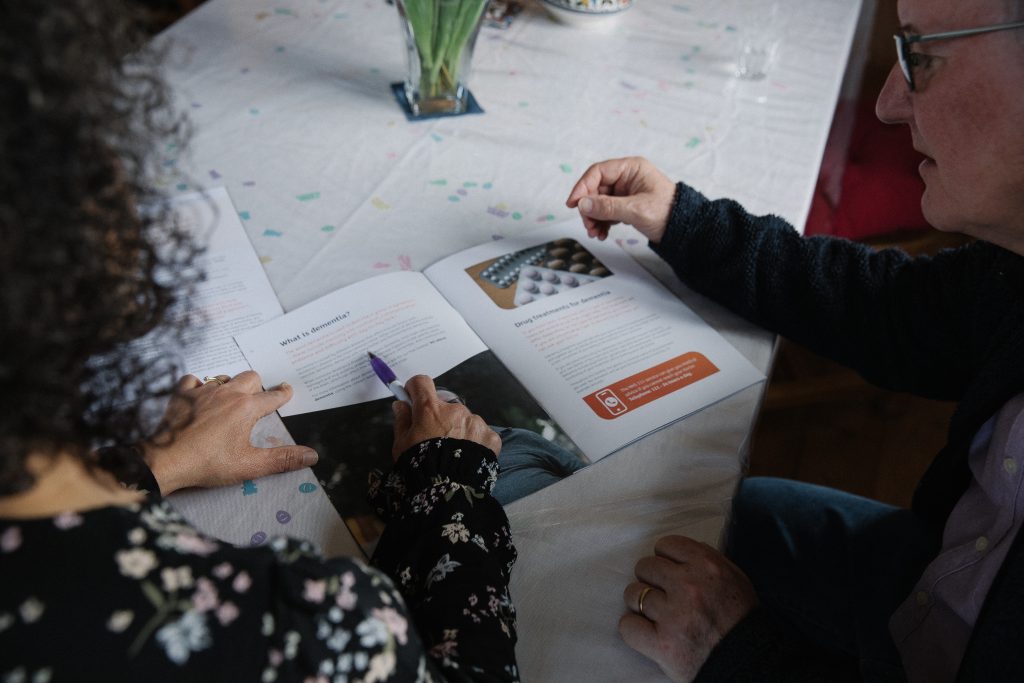
This booklet aims to give an introduction to young onset dementia. It’s for anyone who might be worried about themselves or somebody else.
-

PDF, 3.8 MB, 17 pages
Order health information
Alzheimer's Research UK has a wide range of information about dementia. Order booklets or download them from our online form.

Complete the survey
Was this information helpful?
Let us know what you think by filling out this short survey.

This information was updated in March 2026 and is due for review in March 2028. It was written by Alzheimer's Research UK's Information Services team with input from lay and expert reviewers. Please get in touch if you'd like a referenced copy.
This information is produced with support from The Perfume Shop who had no input into the content.